
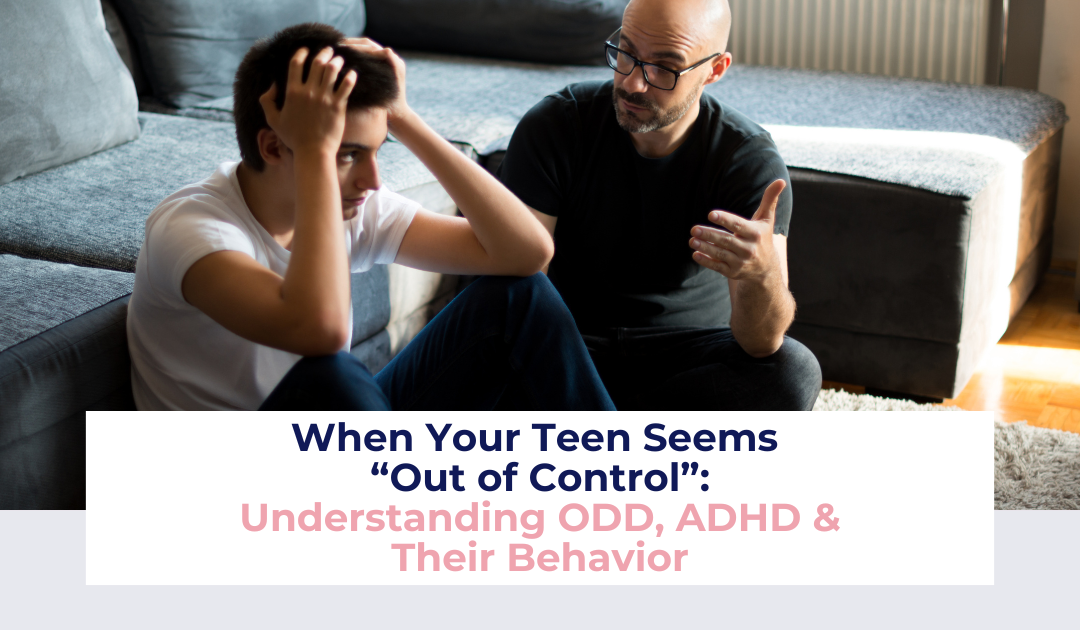
Understanding ODD, ADHD, and What’s Really Happening Beneath the Behavior
If you’ve ever felt like your home has become a battleground instead of a safe place, you’re not alone.
One moment you’re reminding your teen about a missing assignment or a chore.
The next, they’re yelling, slamming doors, walking away, or saying things that leave you stunned and hurt.
And somewhere along the way, you may have heard the term ODD — Oppositional Defiant Disorder — and wondered if that explains what you’re seeing.
Let’s slow this down and look at what “out of control” behavior often really means — especially in teens with ADHD.

What ODD Is — and Why It Comes Up So Often with ADHD
ODD is one of the co-existing conditions associated with ADHD. It is typically described as a pattern of ongoing anger, defiance, and resistance to authority. On paper, it includes behaviors like:
- Frequent arguing with adults
- Refusing to follow rules or requests
- Losing their temper easily
- Blaming others for mistakes
- Acting resentful or spiteful
But in real life, parents don’t experience ‘symptoms’ — they experience moments.
And inside those moments, they’re often trying to figure out not just what’s happening, but how to respond.
In my coaching work and inside the Parent Academy Membership, I see how hard this can be: knowing what this condition looks like on paper is one thing… Knowing how to stay connected and engaged when your teen’s behavior shows up in real time is something entirely different.
ODD may look like this:
A teen who doesn’t take responsibility for their own actions.
A teen who blames others…easily.
A teen who explodes when you mention homework.
A teen who mocks, storms off, or shuts down when you try to help.
A teen who seems like a completely different person when they’re overwhelmed.
And this is where ADHD changes the entire conversation.

When “Defiance” Is Actually a Nervous System in Overdrive
In my coaching work, I see this pattern again and again:
Many teens who look “out of control” are actually overwhelmed, emotionally flooded, and stuck.
The ADHD brain struggles with:
- Starting tasks
- Organizing steps
- Managing time
- Regulating emotions
So when a parent says, “Just go do it,” the teen’s brain doesn’t hear a simple request.
It hears:
“I’m already behind.”
“I don’t know how.”
“I’m failing again.”
When the nervous system flips into fight-or-flight, logic steps aside.
In the ADHD world, we often call this ‘flooding’ — when big emotions overwhelm the brain’s executive functions in the frontal lobe. In that moment, your teen isn’t able to pause, reason, or work through conflict in a healthy way.
Instead, the brain latches onto the strongest thought coming through. And if that thought is anxiety, the body’s only job becomes protection — stay alert, get defensive, or shut down.
What comes out instead is:
- Yelling
- Sarcasm
- Refusal
- Walking away
- Blaming
Not because they don’t care — but because their system is overloaded (and flooded).

The Emotional Layer Most Parents Don’t See: Rejection Sensitivity
Many teens with ADHD experience something called Rejection Sensitive Dysphoria (RSD) — an intense emotional response to perceived criticism, disappointment, or failure. It can feel like a double hit to an already overwhelmed nervous system, often amplifying situations far beyond what anyone expects.
So a simple reminder can feel like:
“You think I’m lazy.”
“You’re disappointed in me.”
“I messed up again.”
When that emotional pain hits, the brain goes into protection mode.
And protection often looks like:
- Pushing you away
- Getting loud
- Getting defensive
- Acting like they don’t care — even when they care deeply

Why Your Teen Pushes Back on Everything
Teens with ADHD hear more corrections in a day than most of their peers.
At school: “Sit still. Pay attention. Turn it in. Try harder. I already shared this with you.”
At home: “Did you do this? Don’t forget that. Why didn’t you…?”
Over time, resistance can become the one place they feel control.
So when you see power struggles, what you’re often seeing is a teen trying to protect their sense of autonomy in a world that constantly tells them they’re “behind.”
Which is why, with my private coaching clients, we work on positive thoughts and a growth mindset. It takes a long time for these teens to “rewire” their thought patterns and what they “hear and absorb” from the world around them.

When ODD May Truly Be at Play
There are times when ODD is an appropriate diagnosis — especially when defiant behavior shows up consistently across:
- Home
- School
- Coaches
- Authority figures
- Peers
But even then, behavior doesn’t exist in a vacuum.
The most powerful question isn’t:
“What’s wrong with my teen?” (they are not broken, nor do they need to be fixed).
It’s:
“What’s making life feel this hard for them right now?”

What “In Control” Actually Looks Like for ADHD Teens
Let’s set realistic expectations.
“In control” doesn’t mean:
- Perfect compliance
- Calm responses every time
- No pushback
Real progress looks like:
- A shorter meltdown instead of a long one
- A teen who says, “I don’t know where to start,” instead of yelling
- A conversation that happens later — when emotions cool down
- A parent who pauses instead of escalating
Those moments are small.
But they’re powerful.

The Parent Shift That Lowers the Temperature
Instead of leading with instructions, try leading with curiosity.
Here are a few coaching-style questions I teach parents that often change the entire tone of a moment:
- “What part of this feels hardest right now?”
- “Do you want help, or do you want space?”
- “What would make this feel more manageable?”
- “If we took a short break, what would you want to start with after?”
These questions don’t remove boundaries.
They remove the power struggle.
A Reframe I Want Every Parent to Hold Onto
If your teen looks “out of control,” I want you to hear this:
You are not parenting a broken child.
You are supporting a developing brain that is overwhelmed, sensitive, and still learning how to regulate itself in a demanding world.
With the right tools, language, and support, those explosive moments can become moments of connection, skill-building, and growth.

You Don’t Have to Do This Alone
Inside my Parent Academy Membership, we spend real time on conversations like this — not just what ODD and ADHD are, but what to say in the moment, how to respond after the moment, and how to rebuild trust over time.
Because progress doesn’t come from getting it right every day.
It comes from showing up — again and again — with compassion, structure, and belief in your teen’s ability to grow.
And if you’re here, reading this?
That already tells me you’re doing more right than you think. 💛