
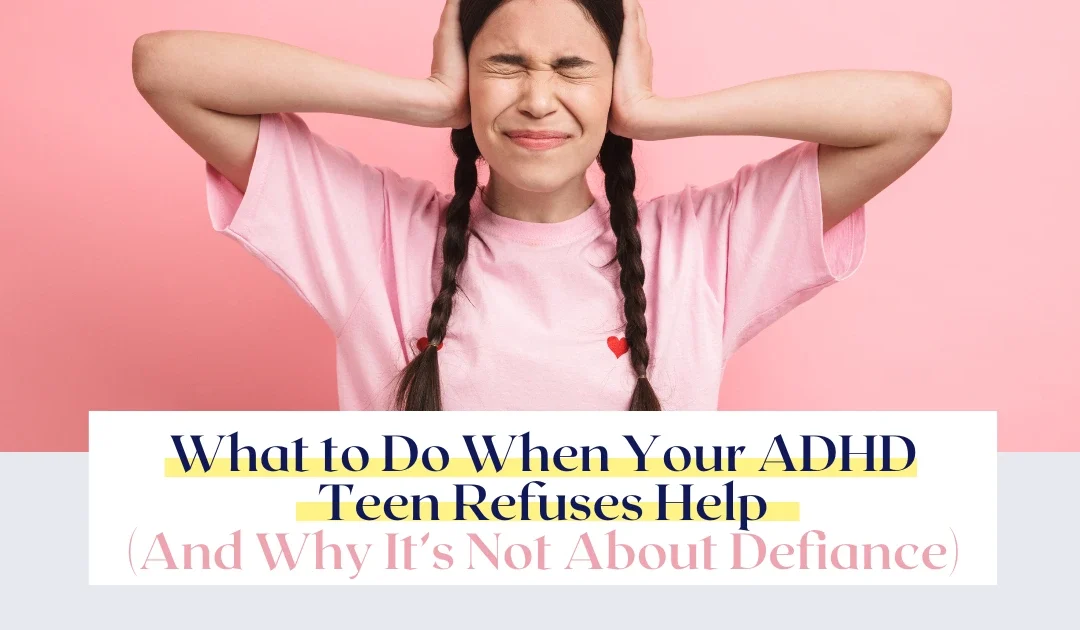
You see your teen struggling.
The late work piling up. The constant stress. The frustration when they can’t seem to get started or stay focused. And when you offer help—kindly, with the best of intentions—they shut you down.
“No, I’m fine.”
“Just leave me alone.”
“ I’ll do it later.”
It’s frustrating. And heartbreaking.
If you’re here, you’re not alone—and neither is your teen.
So let’s unpack what’s really going on when an ADHD teen refuses help, and what you can do instead to move forward with compassion, connection, and real support that works.
It’s Not Stubbornness—It’s Survival
Many parents interpret this refusal as laziness or disrespect. But behind the “I don’t want help” is often a teen who is…
💥 Terrified of failure
💥 Crushed by the fear of being judged
💥 Afraid they’ll try and still fall short
💥 Ashamed they don’t know how to fix it on their own
💥 Overwhelmed by not knowing where to start
This is especially true for teens with Rejection Sensitive Dysphoria (RSD)—a common co existing behavior those with ADHD. RSD causes emotional pain at the thought of disappointing others, being criticized, or not meeting expectations. Even the suggestion of help can feel like a spotlight on their struggles, triggering a fear-based shutdown response.

So What Can You Do Instead?
When a teen is in “protective mode,” logic goes out the window. They aren’t rejecting you—they’re rejecting the feeling of failure, inadequacy, or exposure.
Here’s how you can gently pivot:
1. Validate Before You Educate
Instead of jumping to solutions, start with empathy. Try:
✨ “I know school has felt heavy lately. That makes total sense.”
✨ “You’ve been trying to manage a lot on your own. That takes strength.”
✨ “If I were in your shoes, I’d feel overwhelmed too.”
Validation helps drop the teen’s defenses. When they feel understood, they’re more likely to open up.
2. Offer Help, Don’t Push It
Teens crave independence—but they also crave support. Try saying:
🟡 “Would it help if we figured out a plan together?”
🟡 “I’m here to listen or help break things down when you’re ready.”
🟡 “Do you want me to just sit with you while you work?”
These open-ended offers a bit of independence and control over how help looks.
3. Model That Asking for Help = Strength
In my private coaching program, I work hard to normalize asking for help as a powerful life skill. We talk about how no successful adult has ever done life totally alone.
I say it all the time:
💬 “Asking for help is not weakness. It’s wisdom. It’s a sign of maturity. It’s courage. It’s how you get better at things that matter.”
When teens hear this from someone outside their family, it often sinks in differently. They begin to see support as a tool, not a judgment.
4. Give Them Tools They Can Use Right Away
Many teens resist help because they don’t know what kind of help they need. That’s where scaffolding small wins can shift the game.
Try strategies like:
🟩 Break tasks into mini steps: Instead of “study for the test,” it becomes “open the review guide and highlight key points.”
🟩 Create visual to-do lists: Sticky notes, dry erase boards, or color-coded charts that are easy to see and update.
🟩 Time-bound work bursts: 15 minutes of focused work, then a break. No pressure to finish everything at once.
🟩 Celebrate effort over outcome: Focus on what they did, not just what got turned in.
🟩 Let them fail safely: Sometimes the best teacher is a missed deadline—when it’s followed by reflection and support, not shame.

Final Thoughts: Stay on Their Team
When your teen resists your help, it doesn’t mean they don’t want it deep down. It means they’re scared, stuck, or unsure of how to accept it.
Your calm, consistent presence matters more than you know.
And if you feel like your relationship is stuck in a cycle of shutdowns and tension—this is exactly the kind of thing we work through in private coaching. Teens often open up in a one-on-one setting where they don’t feel the weight of parent-child dynamics. We practice asking for help, advocating for needs, and creating systems that actually work for their unique ADHD brain.
Because here’s the truth:
✨ No one gets through life without help.
✨ And your teen doesn’t have to either.
Let’s teach them that strength looks like reaching out, not powering through alone.

Curious if coaching might be a good fit for your teen?
Reach out to learn more about how I work with high schoolers to build confidence, independence, and self-advocacy—without shame or judgment.
You’ve got this. And I’ve got you. 💛