
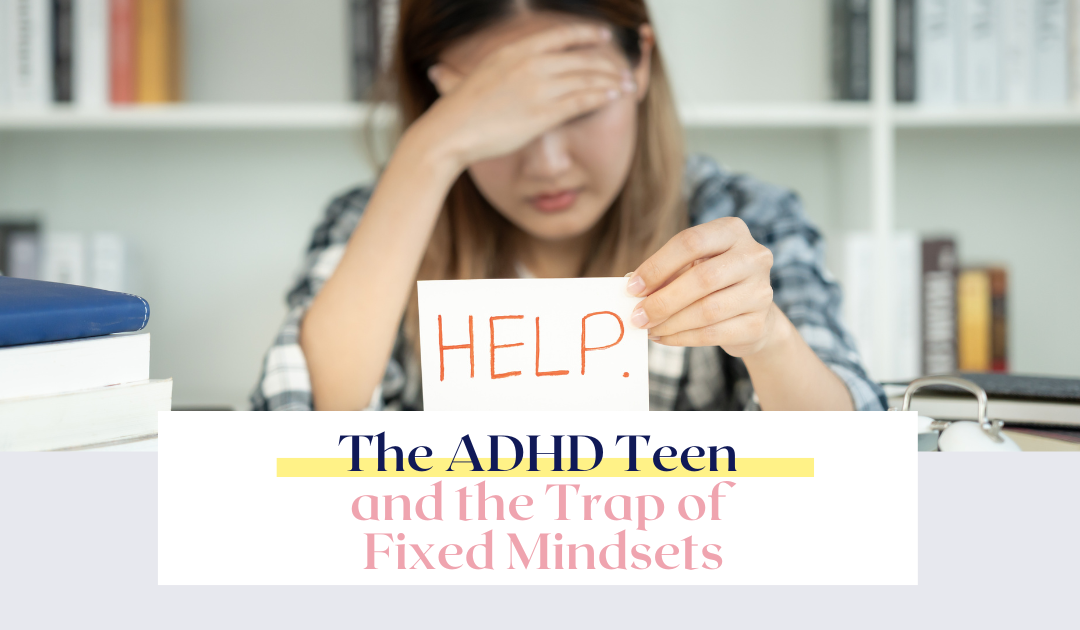
How to Spot Them—and What to Say Instead
If you’ve ever asked your ADHD teen about an assignment and gotten a shrug or a casual, “I’ll do it later,” or “I know, Mom”, you’re not alone. 😅 These moments can be maddening for parents—but underneath the surface, there’s often something deeper going on.
Welcome to the world of fixed mindsets—a mental loop that many ADHD teens get stuck in. It’s hard to parent and it’s hard to coach because we witness these teens get in their own way. And the truth is, these mindsets aren’t laziness or defiance. They’re often protective, automatic thoughts teens use to cope with overwhelm, past experiences, fear of failure and not meeting theirs and your expectations.
Let’s talk about what these mindsets look like and—more importantly—how we can help shift them toward a growth mindset!
🧠 What’s a Fixed Mindset Anyway?
In simple terms, a fixed mindset believes abilities are static—unchangeable. I always describe this as black and white thinking or inflexible thinking/processing. For ADHD teens, this often sounds like:
“I’m just not good at math.” “I can’t focus, no matter what.” “I don’t like the teacher, so I don’t care about the class.” “I’ll do it later.” (…but later never comes) “I don’t need to write it down—I just remember.”
These thoughts become internal rules. And when you believe something’s true, your brain starts looking for evidence to prove it. This is particularly challenging for the ADHD brain, which already processes information differently.

🚧 Why ADHD Makes Fixed Mindsets More Common
ADHD teens live in a world that’s constantly sending them messages that they’re “too much” or “not enough.”
📚 They forget things, get distracted, miss due dates.
👂 They hear corrections more often than praise.
😓 They compare themselves to peers in the classroom and others who seem to learn new things faster.
Over time, this creates a protective shell—”If I don’t try, I can’t fail.” But what starts as self-protection can become self-sabotage. I can’t tell you how many times I’ve shared with my clients that they are literally getting in their own way of success. It’s heartbreaking as a coach witnessing some of these fixed mindsets, especially when children with ADHD have so much potential.

🔁 Common ADHD Mindsets (And How to Shift Them)
Let’s unpack a few frequent fixed mindsets—and some simple language swaps (the same ones I use with my private clients) and strategies you can coach your teen with to develop a growth mindset:
💬 “I’ll do it later.”
What it really means: “I’m overwhelmed and don’t know where to start.”
Growth Mindset Shift: 👉 “Let’s figure out a tiny first step together. You only have to start.”
Strategy: Use timers (Pomodoro), body doubling, or a “just 5 minutes” rule to beat procrastination paralysis. This approach helps the ADHD brain break down overwhelming tasks.
💬 “I just remember things.”
What it really means: “Writing it down feels like extra work. And sometimes I do remember—until I don’t.”
Growth Mindset Shift: 👉 “My brain is smart and it works better when I offload tasks.”
Strategy: Help them build habits around planners, phone alarms, or sticky notes—tools that feel like helpers, not punishments. Remember, hard work includes finding systems that work with your unique brain.
💬 “I don’t like the teacher, so I don’t talk to her.”
What it really means: “I feel uncomfortable or misunderstood.”
Growth Mindset Shift: 👉 “I can learn to advocate for myself—even with people I don’t click with.”
Strategy: Roleplay neutral, respectful ways to ask for help. There are so many times I walk through a conversation (or write an email) with my private clients on how to approach a teacher they don’t like. Empower your teen with scripts that feel safe and manageable.
💬 “I’m just bad at this.”
What it really means: “I’ve failed before, and I don’t want to feel that way again.”
Growth Mindset Shift: 👉 “I’m still learning. It’s okay to struggle and keep going. Even if I’ve failed before, doesn’t mean I will again.”
Strategy: Celebrate effort, not just outcomes. Share stories of your own “fail-forward” moments. Growth mindsets thrive in encouragement, and this is especially important for teens with ADHD symptoms like rejection sensitivity.

✨ How You Can Help as a Parent
Fixed mindsets don’t shift overnight. But with calm consistency, you can help rewire how your teen thinks about challenges. This concept, popularized by psychologist Carol Dweck, shows us that mindsets can change with time and practice.
Here’s how:
- Model growth thinking. Talk openly about mistakes and what you learned.
- Ask open-ended questions like: “What part felt hard?” instead of “Why didn’t you do this?”
- Use “yet” language. “You haven’t figured this out yet. Let’s work on it together.”
- Celebrate progress—no matter how small. Teens need to feel their wins, especially when dealing with ADHD challenges.
Remember, developing a growth mindset ADHD approach takes time, but it’s one of the most powerful things you can teach your child.

🌱 Final Thoughts: It’s Not Just Mindset. It’s a Skill Set.
Changing how your teen thinks isn’t just about positivity—it’s about building real tools and habits that support executive function growth. Psychology research shows us that when children believe they can improve through effort and learning, they’re more likely to persist through challenges.
And if you’re reading this wondering if it’s too late—it’s not. Every conversation, every tiny shift, adds up. The journey from fixed mindset to growth mindset is ongoing, and your support makes all the difference.
Cheering you on as you help your teen turn “I can’t” into “I’m learning.”
💬 Want more ADHD mindset shifts and practical tips? Grab my free eBook: [5 Keys to Empowering Your Teen with ADHD]!